
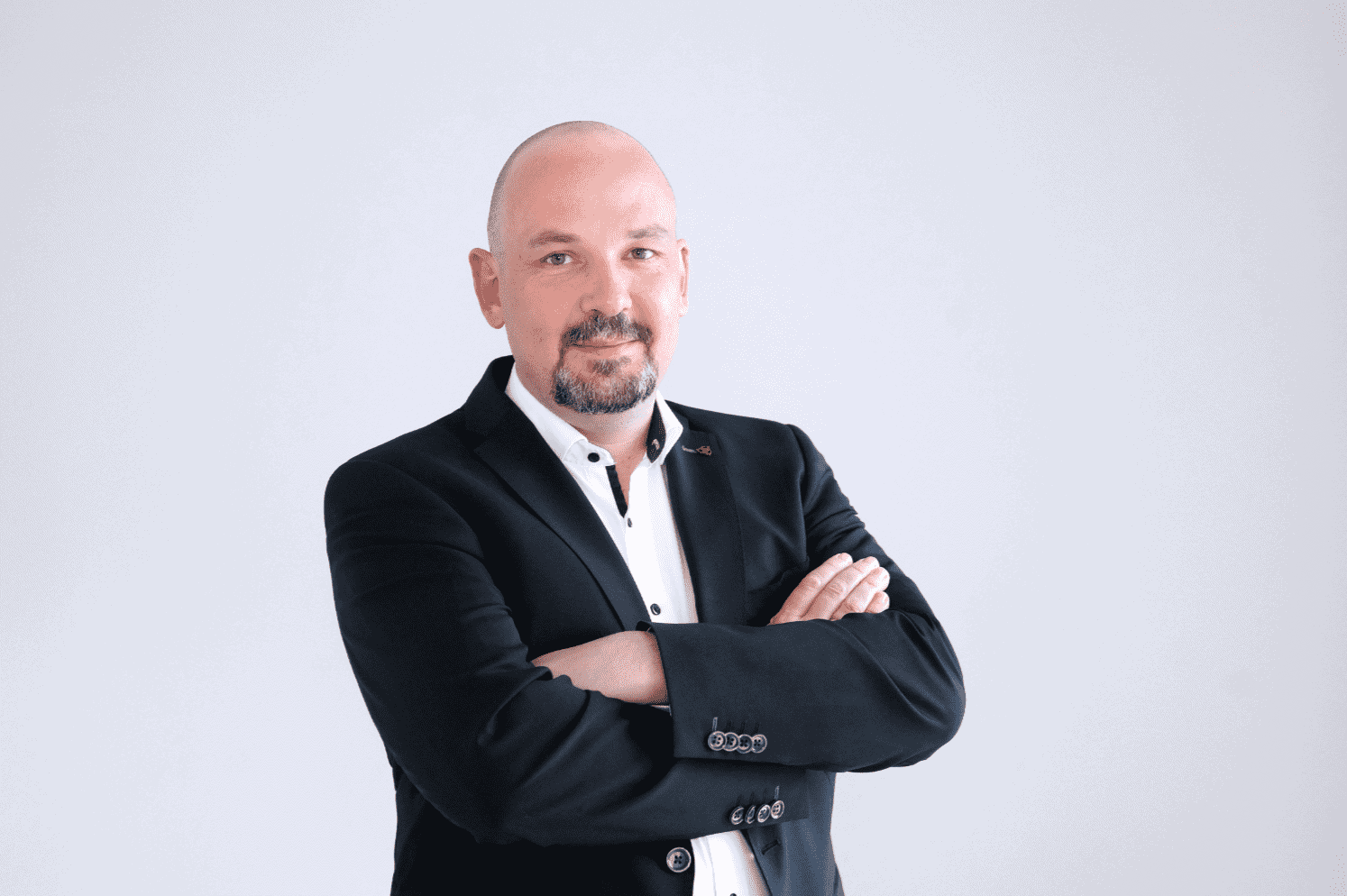
Florian Scherer – VP of Development
The automotive industry is in the middle of a massive transformation. While electrification and connectivity grab most of the headlines, user experience has quietly become just as crucial. Today, comfort electronics and advanced lighting are no longer just supporting features, rather they are frontline essentials for innovation, brand identity, and differentiation.
Leading this charge for APAGCoSyst is Florian Scherer, Vice President of Development. Florian heads our global R&D organization, bridging teams across Canada, Germany, and India. Since stepping into the role, his main focus has been building a highly connected, global engineering ecosystem that pairs close customer collaboration with scalable, cost-efficient development. Under his leadership, APAGCoSyst continues to advance key technologies like BLDC motor control, sensor systems, and smart lighting all built on a rigorous foundation of functional safety and cybersecurity
A Fresh Perspective on Global R&D
You joined APAGCoSyst directly as the Vice President of Development. Coming into the company straight into this leadership role, what were your immediate impressions, and how did you approach taking on the global R&D organization?
Stepping right into the head of R&D role actually gave me a distinct advantage. Coming in fresh allowed me to look at our operations with an outside perspective and question existing setups more openly.
That said, it didn’t take long to realize just how much deep technical expertise we have across our teams, and how incredibly open people are to collaboration. My immediate priority wasn’t to change everything overnight, but to listen. I wanted to connect our people across different global locations first, and then use that collective strength to map out a clear, unified direction for the organization.
As you step into this role, what are your main priorities for the R&D team?
The main priority is to move towards a truly global R&D organization. Today we already have strong teams in Canada, Germany, and India; but the real value comes from connecting them more closely.
The idea is quite simple: stay close to the customer with local presence and communication in the same time zone, while also using global development capabilities to stay competitive.
In parallel, we are working on more standardized processes, stronger system architecture capabilities, and making sure that topics like functional safety and cyber security are built into all our developments.
Where Technology is Going
Which technology trends do you believe will shape the automotive and electronics industries over the next few years?
What we currently see is less about individual trends and more about everything coming together.
Development is clearly shifting from a function-based approach to system-level thinking. Vehicles are becoming highly connected systems where sensing, processing, and actuation are tightly linked.
For example, actuators, especially BLDC-based ones; are no longer just doing a job. They are intelligent subsystems with control loops, diagnostics, and communication. The same applies to sensor systems, which are increasingly important for interaction.
HMI is changing as well. More and more functions are integrated into surfaces using capacitive sensing, which makes the interaction more intuitive but also technically more demanding.
Lighting is another good example. It’s no longer just about illumination, it’s becoming part of the interaction and overall experience.
And across all of this, two topics are becoming unavoidable, are functional safety and cyber security. With increasing connectivity and system complexity, both need to be considered from the very beginning, not added later.
What challenges come with this increasing complexity in modern systems?
The biggest challenge is definitely managing complexity across all domains.
You’re not just dealing with hardware anymore; you have software, communication layers, and data flows that all have to work together reliably. Ensuring reliable, predictable behavior and meeting standards like ISO 26262 requires a solid architecture and clear processes.
Also, connectivity opens the door for cyber security risks, which need to be addressed carefully following standards like ISO/SAE 21434.
Another topic is validation. You don’t just test functionality anymore, you also have to validate safety concepts and security aspects. That significantly increases effort.
Without a modular approach, standardization, and strong alignment across teams, this quickly becomes unmanageable.
APAGCoSyst’s Approach to Innovation
How is APAGCoSyst positioned to adapt to these evolving technologies?
One of our strengths is that we don’t look at things in isolation. We combine electronics, embedded software, and industrialization.
With our focus on BLDC motor control, sensor systems, and lighting, we are able to develop complete subsystems, from sensing all the way to actuation.
We are continuously building up capabilities in functional safety and cyber security and integrating them early into the development process.
Another important aspect is our platform approach. By working with modular building blocks, we can scale solutions more efficiently across projects and customers.
What role does collaboration between R&D, automation, and production play in successful development?
It’s absolutely essential.
Many of the key decisions are made early in development, but their impact is often only visible later in production. That’s why close alignment from the beginning is so important.
Topics like manufacturability, testability, and cost are directly influenced by engineering decisions. As mentioned, requirements from functional safety (like traceability) and cyber security also need to be reflected in production and testing processes.
A strong design for manufacturing and test mindset helps to bring all of this together.
Insights from Tech Day
APAGCoSyst recently hosted Tech Day. What stood out to you most from the experience?
What stood out most was the level of openness in the discussions.
It wasn’t just about presenting technologies, it was really about exchanging ideas with customers and partners and talking about real challenges. That makes a big difference.
Do events as such reinforce any particular direction or opportunity for APAGCoSyst?
Yes, definitely.
It confirmed that we are focusing on the right areas, especially actuators, sensor systems, and lighting. This showes that the real potential lies in combining these technologies into integrated solutions.
It also made clear how important system integration, safety, and security have become as differentiating factors.
Looking Ahead
What excites you most about the future of R&D at APAGCoSyst?
What excites me most is the opportunity to really shape a global organization.
If we manage to connect our teams across all our regions effectively, we can combine speed, innovation, and cost efficiency in a very powerful way. That will be a key factor going forward.
If you had to describe the future of innovation at APAGCoSyst in one sentence, what would it be?
Building a team that can develop safe, connected systems anywhere in the world, and do it well.